Category:
BollywoodBatwara 1947 Cast Fees: Sunny Deol's 60 Crore Paycheck Decoded
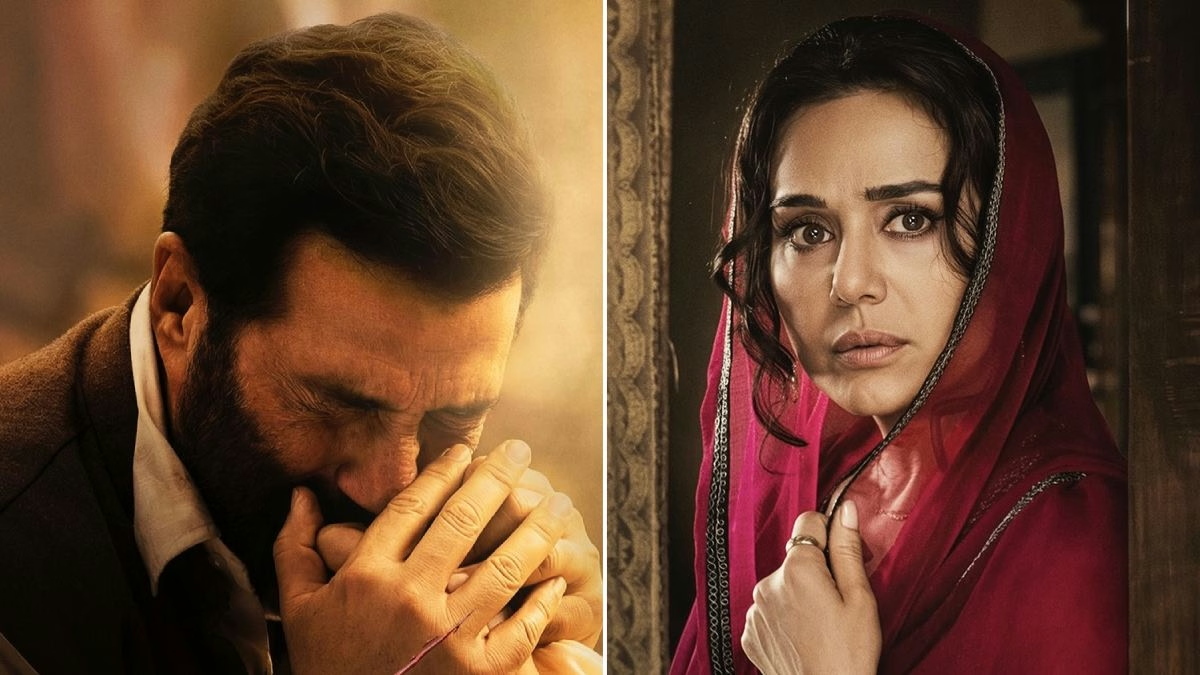
When a period drama commands a budget of 120 crores, the real story often lies not just in the narrative on screen, but in the astronomical figures behind the scenes. 🎬 Batwara 1947, helmed by veteran director Rajkumar Santoshi and produced by Aamir Khan Productions, has become the subject of intense industry scrutiny—not for its ambitious scope, but for what appears to be a staggering disparity in cast remuneration that raises eyebrows across Bollywood.
The partition-era drama, based on Asghar Wajahat's acclaimed theatrical work "Jis Lahore Nai Vekhya, O Jamya E Nai," has assembled an impressive ensemble featuring Sunny Deol, Preity Zinta, Shabana Azmi, Ali Fazal, and Karan Deol. Yet behind this glittering lineup lies a financial structure that tells a far more intriguing tale about contemporary star power, market dynamics, and the shifting economics of Hindi cinema. ✨
The 120 Crore Budget Breakdown: Understanding the Investment
Initially, industry insiders speculated that Batwara 1947 would maintain a lean budget of 70-80 crores, particularly given that substantial portions were shot within controlled studio environments. However, the actual budget balloon to 120 crores—a significant jump that immediately sparked questions about where precisely these funds were being allocated. 💰
This isn't merely a number game. The budget expansion reflects the production's ambitions to recreate the historical authenticity of the 1947 partition era, including period-accurate sets, costumes, and production design. Yet the real revelation came when industry observers began analyzing the cast fee structure—a breakdown that would make even seasoned Bollywood analysts pause.
Sunny Deol's Astronomical 60 Crore Paycheck: The Post-Gadar 2 Effect 🌟
Sunny Deol's market value underwent a seismic shift following the unexpected blockbuster success of Gadar 2, which shattered box office expectations and reminded audiences of the veteran actor's enduring appeal. The film's triumph, coupled with the subsequent success of Border 2, fundamentally altered how producers and studios valued the action superstar's commercial magnetism.
According to industry reports, Sunny Deol has reportedly commanded a staggering 60 crore fee for Batwara 1947—representing a full 50% of the film's entire production budget. To contextualize this figure: in an era where even A-list Bollywood celebrities typically command 15-25 crore per project, a 60 crore paycheck positions Sunny Deol in an elite echelon previously reserved for the industry's most bankable superstars.
This fee structure essentially means that half of every rupee invested in Batwara 1947 goes directly to compensating its male lead. For a period drama with an ensemble cast, this concentration of budget allocation raises intriguing questions about risk management, star power valuation, and the producer's confidence in Deol's box office pull.
The 500% Disparity: Preity Zinta's 10 Crore vs. Sunny Deol's 60 Crore 📊
Perhaps the most striking revelation involves the compensation structure between Batwara 1947's lead pair. Preity Zinta, making her significant theatrical comeback to play Sunny Deol's on-screen wife, has reportedly been offered 10 crore—a respectable figure by contemporary standards, yet dwarfed by her male co-star's remuneration.
The mathematics here are sobering: Sunny Deol's 60 crore fee is precisely 500% higher than Preity Zinta's 10 crore compensation. This six-fold difference illuminates a persistent reality in Hindi cinema—the massive valuation gap between male and female stars, even when both carry significant box office credentials and marquee appeal.
For context, Preity Zinta remains one of Bollywood's most bankable actresses, with a filmography spanning commercially successful projects and critical acclaim. Her return to mainstream cinema after a hiatus was anticipated to be a significant draw. Yet the fee disparity suggests that the industry continues to price female leads substantially lower than their male counterparts, regardless of their individual market positioning.
Supporting Cast Economics: Ali Fazal, Shabana Azmi, and Karan Deol 🎭
The supporting cast structure provides additional insights into Batwara 1947's financial architecture:
Shabana Azmi, the powerhouse performer playing a central character within the partition narrative, reportedly commands 3 crore. Despite her legendary status and the substantial role she occupies within the film's emotional core, her compensation reflects the reality that even critically acclaimed performers earn considerably less than commercial male leads.
Ali Fazal, portraying a poet character in Pakistan, has reportedly secured 7 crore—positioning him as the second-highest-paid performer after Sunny Deol. This reflects both his rising market value and the significance of his character within the narrative structure.
Karan Deol, Sunny Deol's son, along with Abhimanyu Singh, have each reportedly negotiated 2 crore for their respective roles. Karan Deol's involvement adds a familial dimension to the project, potentially offering him valuable experience working alongside established industry figures.
Industry Context: Star Fees in Contemporary Bollywood 💫
Understanding these figures requires situating them within the broader landscape of Hindi cinema compensation structures. The industry has witnessed significant inflation in star fees over the past five years, driven by:
- Streaming platform competition: OTT services have inflated actor compensation expectations across the board
- Box office recovery: Post-pandemic theatrical resurgence has renewed producer confidence in big-budget projects
- Global audience expansion: International recognition increasingly factors into fee negotiations
- Franchise success: Successful sequels (like Gadar 2) dramatically elevate associated actors' market valuations
Within this context, Sunny Deol's 60 crore fee, while exceptional, reflects the compounding effect of his recent box office successes and the production's apparent confidence in his drawing power.
The Gender Pay Gap in Hindi Cinema: A Persistent Challenge ⚠️
The Batwara 1947 compensation structure underscores a conversation that has dominated industry discourse for years: the systematic undervaluation of female performers relative to male counterparts. The 500% differential between Sunny Deol and Preity Zinta extends beyond this single project—it represents a systemic pattern.
Recent industry analyses indicate that:
- Female leads typically earn 30-40% of what male leads command, even in ensemble projects
- Supporting female actors face even steeper compensation differentials
- The gap widens for actresses returning after career breaks, as Preity Zinta's situation illustrates
- International box office appeal rarely translates to proportional fee increases for female stars
This disparity persists despite evidence that female-led or female-fronted films often deliver comparable or superior returns on investment compared to male-dominated projects.
Box Office Implications and Commercial Viability 🎯
With 120 crores invested and half that amount concentrated in a single actor's paycheck, Batwara 1947 carries substantial commercial pressure. The film must navigate a competitive theatrical landscape while justifying its considerable budget through box office performance.
The partition drama faces additional headwinds, including competition from other releases and the inherent challenge of period dramas—a genre that, while critically respected, doesn't always translate to blockbuster numbers. The financial structure suggests producers are banking heavily on Sunny Deol's post-Gadar 2 momentum to carry the project to profitability.
What These Numbers Reveal About Bollywood's Economics 🔍
The Batwara 1947 compensation breakdown functions as a revealing window into contemporary Hindi cinema's economic realities:
- Star power remains paramount: In an era of streaming alternatives and fragmented audience attention, established stars command premium pricing
- Box office success translates immediately: Gadar 2's performance directly inflated Sunny Deol's market value
- Gender disparity persists systematically: Female actors, regardless of credentials, remain systematically undercompensated
- Risk concentration: Producers increasingly concentrate budget allocation with lead actors, reflecting risk-averse strategies
- Ensemble economics: Supporting actors occupy a middle tier with modest but meaningful compensation
Looking Ahead: Industry Trends and Future Implications 🚀
The Batwara 1947 fee structure raises questions about sustainability. As production budgets continue escalating and star fees inflate correspondingly, the economics of Hindi cinema face pressure. When 50% of a film's budget goes to a single performer, break-even becomes increasingly challenging.
Industry observers anticipate potential shifts in how producers approach star compensation, potentially including:
- Greater emphasis on backend profit-sharing rather than upfront fees
- Increased investment in ensemble projects with more balanced compensation structures
- Growing producer pushback against astronomical star fees
- Potential opportunities for emerging talent to command better negotiating positions
The partition drama ultimately becomes a case study in contemporary Bollywood economics—revealing how box office success translates into market power, how gender disparities persist within the industry's compensation frameworks, and how producers continue gambling on established stars to justify increasingly substantial production investments.
Whether Batwara 1947 justifies its ambitious budget and Sunny Deol's premium compensation will determine not just the project's commercial fate, but potentially influence how the industry structures future deals. 🎬
You May Also Like

Bollywood
T-Series Pan-India Strategy: How Bhushan Kumar Is Redefining Indian Cinema
September 2, 2026
Bollywood
Gandhari Trailer Review: Taapsee Pannu's Fierce Mother
September 1, 2026

Bollywood
Ali Fazal Reveals Where Mirzapur: The Movie Picks Up
September 1, 2026

Bollywood
Daayra Poster Reveals Kareena & Prithviraj's Intense Showdown
September 1, 2026