Category:
BollywoodSunny Deol Blasts Shabana Azmi Over Gadar Criticism
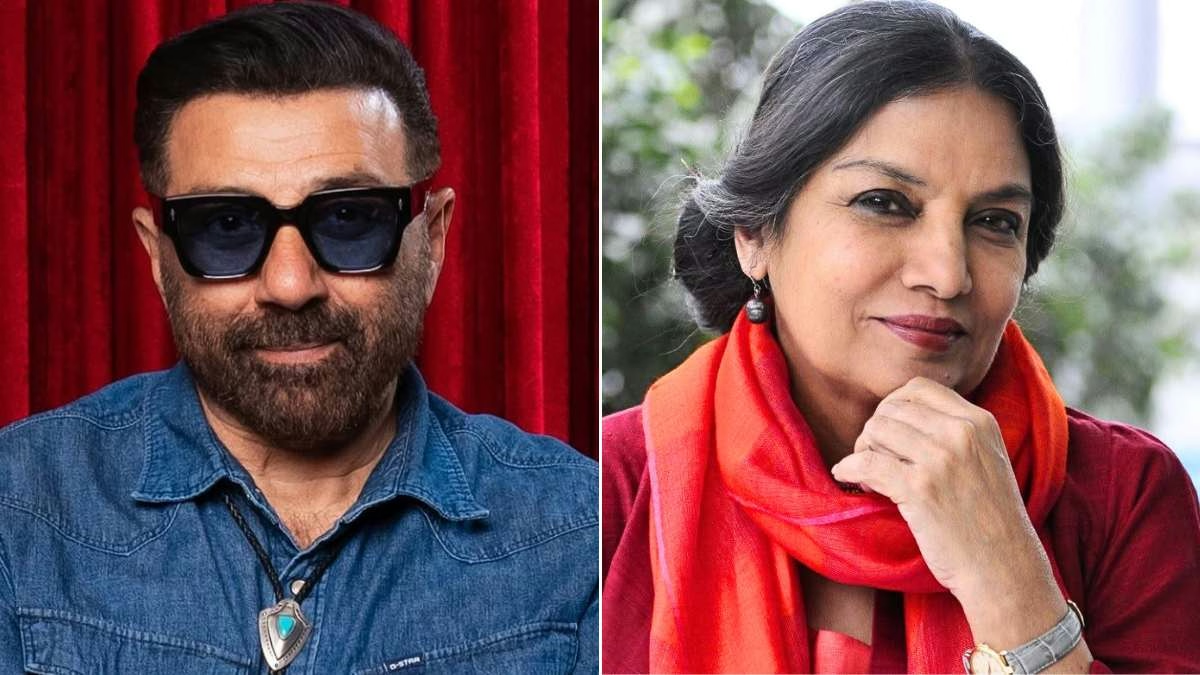
When Two Bollywood Titans Clashed Over Art and Ideology 🎬
The world of Indian cinema has always been a battleground of ideas, where artistic expression meets social responsibility. Few confrontations in Bollywood history capture this tension quite like the explosive exchange between Sunny Deol and Shabana Azmi over the 2001 blockbuster Gadar: Ek Prem Katha. What started as film criticism evolved into a heated debate that divided audiences, critics, and the film fraternity itself.
But here's where the story takes an intriguing turn—more than two decades later, these two cinematic powerhouses found themselves reunited on screen in Rajkumar Santoshi's ambitious Partition drama Batwara 1947, creating a narrative of redemption and full-circle moments in the Indian film industry.
The Gadar Phenomenon: Box Office Gold Meets Social Controversy 💥
When Anil Sharma's Gadar hit theaters in 2001, it didn't just break records—it shattered them. The film became a cultural phenomenon, earning unprecedented box office numbers that established Sunny Deol as an action superstar of unparalleled magnitude. The movie's narrative of a Hindu hero fighting against Pakistani antagonists during the Partition era resonated powerfully with mainstream audiences across India.
Yet beneath the glittering commercial success lay a storm of criticism. Political commentators, film critics, and social activists questioned the film's portrayal of religious and national identities. The narrative structure—featuring a virtuous Hindu protagonist battling against Muslim villains—became the focal point of intellectual discourse about how cinema represents history and shapes public perception.
The film's approach to Partition, one of history's most traumatic events, drew particular scrutiny. Rather than exploring the nuanced human tragedies that defined this period, critics argued that Gadar simplified complex geopolitical tensions into a straightforward good-versus-evil framework.
Shabana Azmi's Intellectual Challenge 📚
Among the film's most vocal critics was Shabana Azmi, the acclaimed actress and intellectual known for her progressive stance on cinema and society. Her concerns weren't rooted in mere artistic preference but in deeper questions about representation and responsibility.
Azmi articulated her reservations with characteristic eloquence, suggesting that the film conflated nationalism with religious identity in problematic ways. She expressed concern that Gadar presented Muslims as inherent adversaries rather than exploring the shared suffering that defined the Partition experience for people across religious lines.
Her criticism highlighted a fundamental tension in Indian cinema: the balance between entertaining mass audiences and maintaining intellectual honesty about historical narratives. Azmi's perspective represented the viewpoint of a significant section of India's cultural intelligentsia who believed that cinema had a responsibility to complicate rather than simplify historical trauma.
Sunny Deol's Fiery Response: The Filmfare Interview 🔥
Sunny Deol didn't take the criticism lying down. In a notably candid Filmfare interview, the action icon unleashed his frustration directly at Shabana Azmi and other detractors. His response was raw, emotional, and unapologetic—characteristics that defined his public persona.
Deol expressed genuine disappointment that someone of Azmi's intellectual stature would, in his view, misread the film's intentions. He argued that the story's foundation lay in its historical setting during Partition, with no deliberate agenda to wound religious sentiments or promote divisive ideologies. According to Deol, the protagonists were portrayed as "pure and innocent," suggesting that the film operated within the realm of romantic storytelling rather than political commentary.
The actor's frustration extended to what he perceived as opportunistic criticism. He suggested that some detractors were leveraging the film's success to gain media attention rather than engaging in genuine artistic discourse. For Deol, the film's massive public acceptance served as vindication—audiences had embraced the story without the ideological baggage that critics imposed upon it.
"Those who thought the film projected an anti-national stance... have warped minds," Deol declared, his words reflecting the genuine hurt he felt at being misunderstood.
The Broader Context: Cinema and National Identity in India 🇮🇳
This clash between Deol and Azmi represented something far larger than a personal disagreement. It embodied a fundamental philosophical divide about cinema's role in shaping national consciousness.
On one side stood the perspective that cinema should primarily entertain and that audiences were sophisticated enough to distinguish between storytelling and ideology. On the other side was the conviction that cinema, particularly when dealing with sensitive historical events, carried an inherent responsibility to present balanced, nuanced narratives.
The Gadar controversy coincided with a period when Indian cinema was increasingly becoming a vehicle for exploring national identity. Films like Lagaan, Hey Ram, and Rang De Basanti would later continue this conversation, each offering different perspectives on what it meant to be Indian and how cinema should represent that identity.
Two Decades Later: Life Comes Full Circle in Batwara 1947 🎭
Fast forward to 2026, and the universe orchestrated a remarkable reunion. Rajkumar Santoshi's Batwara 1947 brought Sunny Deol and Shabana Azmi together once again, but with a fascinating twist that seemed almost poetic in its irony.
In this Partition drama, the narrative dynamics completely flip. Deol portrays Sikandar, a Muslim migrant in Lahore who embodies strength, compassion, and moral conviction. His character's defining mission involves protecting an elderly Hindu woman—a role essayed by none other than Shabana Azmi. The film transforms the previous dynamic entirely, presenting a Muslim protagonist as the moral center and savior figure.
This casting choice and narrative reversal suggest a maturation in how Indian cinema approaches historical storytelling. Rather than remaining entrenched in their previous positions, both actors came together to explore a more complex, humanistic vision of Partition that transcends religious boundaries.
What This Reunion Means for Indian Cinema 🌟
The collaboration between Deol and Azmi in Batwara 1947 represents something profound about the evolution of Indian cinema and its artists. It suggests that even heated disagreements about artistic vision don't have to define careers or relationships permanently.
Both actors demonstrated the maturity to move beyond their previous conflict and engage with new material that offered fresh perspectives. This willingness to evolve—to question one's own previous positions and explore different narratives—speaks to the intellectual growth that can occur in an artist's career.
For audiences, the reunion offers an opportunity to revisit the Gadar controversy with historical perspective. Twenty-five years later, we can appreciate both the film's entertainment value and the legitimate concerns critics raised about representation and narrative complexity.
The Lasting Impact on Bollywood Discourse 💭
The Deol-Azmi confrontation established a precedent in how Indian cinema discusses sensitive historical and political themes. It demonstrated that major stars and respected intellectuals could engage in substantive debate about cinema's role in society without resorting to personal attacks or industry ostracism.
This discourse influenced how subsequent films approached historical narratives. Filmmakers became increasingly aware that audiences and critics would scrutinize not just entertainment value but also the ideological underpinnings of their stories.
The controversy also highlighted the importance of intellectual diversity within the film industry. Having voices like Azmi's willing to challenge mainstream narratives ensures that cinema remains a space for genuine artistic and philosophical exploration rather than mere commercial enterprise.
Conclusion: Art, Criticism, and Growth 🎬✨
The Sunny Deol-Shabana Azmi saga reminds us that cinema exists at the intersection of entertainment, art, and ideology. Their initial conflict, while heated, contributed meaningfully to conversations about how Indian cinema represents history and identity.
Their eventual collaboration in Batwara 1947 suggests that artistic disagreements need not be permanent. Instead, they can serve as catalysts for growth, reflection, and the creation of more nuanced, complex narratives.
For cinephiles and industry observers, this reunion represents a beautiful full-circle moment—proof that even the most contentious creative disputes can evolve into opportunities for deeper artistic exploration. It's a reminder that the best cinema emerges not from consensus but from the productive tension between different perspectives, all working toward creating stories that resonate with audiences while challenging them to think more deeply about the world around them.
You May Also Like

Bollywood
T-Series Pan-India Strategy: How Bhushan Kumar Is Redefining Indian Cinema
September 2, 2026
Bollywood
Gandhari Trailer Review: Taapsee Pannu's Fierce Mother
September 1, 2026
Bollywood
Ali Fazal Reveals Where Mirzapur: The Movie Picks Up
September 1, 2026
Bollywood
Daayra Poster Reveals Kareena & Prithviraj's Intense Showdown
September 1, 2026